
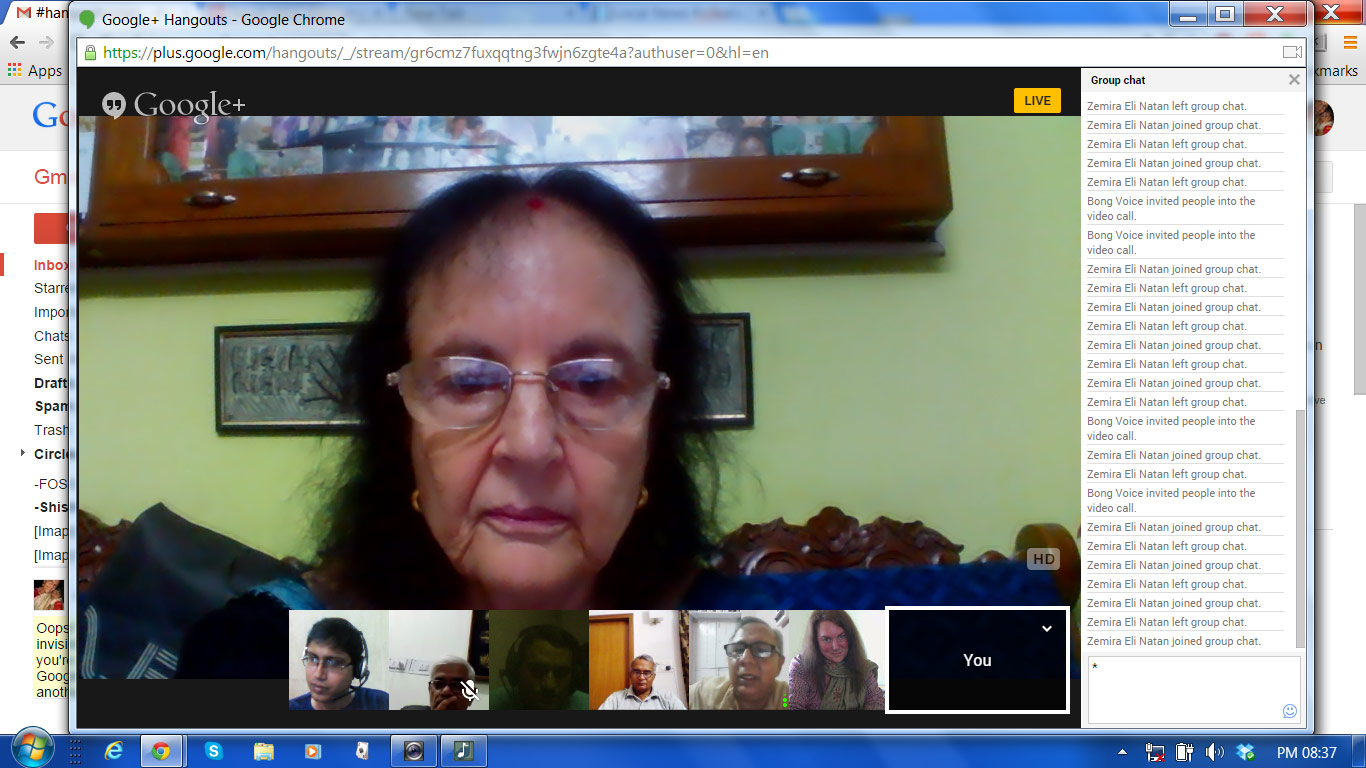
Screenshot of Panel, but my mic was not recognized.
This is an unpublished blog from 2008 that I just came across recently, and thought it timely. I had been invited to be on a live panel addressing the question, “Is the World Polarizing on the Basis of Religion?” The audio failed so I was not able to contribute to the discussion.
Here were my thoughts at the time:
I’m writing from Kolkata, West Bengal, an Indian state currently experiencing “communalism,” roughly equivalent to what is known elsewhere as sectarianism. I’m trying to figure out how to say what is on my mind without running afoul of the laws as they are applied here. I can be arrested for writing, saying, or tweeting something that offends the religious sensitivities of Muslims. And while the law is applicable to any religious group, the reality on the ground is that it is used as a means to protect Muslims from what and who might offend them, and that includes questioning or breaking their laws of Sharia and blasphamy.
How can we have open discussion and debate if “offending” is a crime? “Offended?” Who can live without being offended? We teach our children, “Sticks and stones may break my bones, but names will never harm me.” We know it is not completely true, but we use it to teach about restraint. The second part of the “offended” narrative is that being offended becomes an excuse for violent behavior. In other words, if I/we “offend” a religious group and they begin rioting, I/we are said to have “incited rioting.” By law then, I become responsible for their feelings and their behavior due to their feeling offended. Some might think I’m exaggerating, but unfortunately I have had first hand experience with all of this.
How can we have reasoned debate if emotion is allowed to be expressed with violence? How has rioting become a socially acceptable form of protest over hurt feelings? For me, Kolkata changed from secular to sectarian in December 2007. Muslims rioted in the city demanding that Taslima Nasreen a novelist, be expelled from Kolkata. http://news.bbc.co.uk/2/hi/south_asia/7105277.stm)
“Wednesday’s trouble in the state capital began after the predominantly Muslim All-India Minority Forum called for blockades on major roads in the city. The group said Ms Nasreen had ‘seriously hurt Muslim sentiments’ “.
The Indian army was called in. And then I heard that people I knew personally as the most liberal and secular leadership of the Muslim community of Kolkata,were also calling for her removal! Kolkata was no longer a secular city, and it was clear where the power lay. Just three months before, the city had come together over the murder of a young Muslim man who had married a Hindu woman. The outrage seemed to be shared by Hindus and well as Muslims. I remember thinking that this was something I loved about Kolkata. It was what people wanted for Kolkata. That seems like ages ago.
More recently there were riots because a newspaper published photographs that offended Muslims. The police arrested the editors of the newspaper. None of this is unique to Kolkata or India anymore. Moderate becomes a meaningless term in the face of violence. And in my years in Kolkata, I’ve never heard any Muslim protests against riots against Taslima Nasreen, or against arresting editors when they publish what offends Muslims.
People pick and choose what part or parts of their religion they want to follow. This happens in every religion. But we don’t hear Muslims saying, “I am a proud Muslim but I am against sharia, stoning, polygamy, slavery.” or “I am a proud Muslim and I renounce violence.” Where are the Muslim conscientious objectors? Actually I believe they exist but they too are at risk. But until they share their plight, they leave the world believing that Islamic Terrorism does indeed speak for Islam. Why must they speak? Only Muslims carry the credibility. An Imam speaking against sharia, against beheading, against the killing of infidels carries credibility.
My evolution in thought:
I came to India thinking of it as a Hindu country. But when our children were studying Indian history in school, all of the Muslim invasions and conquests of the Hindus were described in a celebratory way. Each period was described by whether they were good or not to the original inhabitants. I thought, “Oh, so Hindus lost,” because it’s the winners who get to write the history books. When I started to ask questions here, people bent their heads and whispered, “yes. but we can’t talk about it.” And that is when I started to dig deeply into the history of India, this country I have come to call home.
It’s 2023 now and I’m still not sure it’s safe to talk about so I’ll just whisper-blog for now.
 Words
Words 